

Specialist Wood Worktop Scorch, Burn & Heat Ring Repair
Professional Timber Burn Remediation
If a boiling pot, searing hot baking tray, or a piping hot coffee mug has left a dramatic black carbon scar or a hazy white cloud on your beautiful wood kitchen worktops, the surface protection hasn't just failed—the timber cells themselves have been damaged by the heat.
A common DIY reflex is to grab a belt sander or a coarse sanding block and aggressively grind down directly over the black mark. This is a critical mistake. Because heat burns sink deep into the timber grain, localized, heavy-handed sanding will quickly cut an irreversible dip or "bowl" into your flat worktop profile. When the light catches the surface, you’ll be left with a permanent, highly visible wave across your kitchen workspace.
With 20 years of specialized timber restoration experience, we deploy a highly controlled, mechanical process to safely remove scorched wood tissue and seamlessly blend the repair area into the surrounding work surface, ensuring the surface maintains a flat profile.
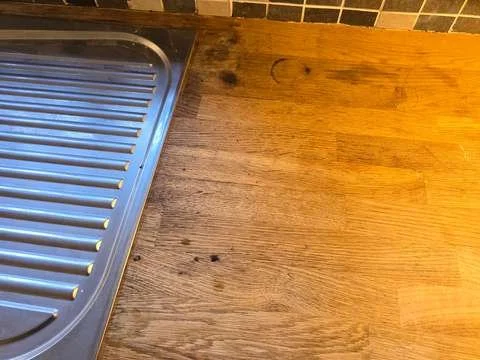
Small burns on a worktop created by a candle lit oil burner exploding.
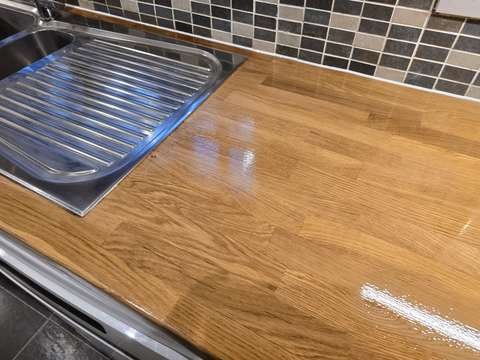
We removed all the burn marks from this oak worktop and renewed the entire surface finish.
The Two Types of Heat Marks (And How We Fix Them)
We treat heat marks based on how deep the thermal energy has penetrated the wood fibers:
Deep Black Scorches & Burns: When extreme heat directly hits unprotected wood, it triggers chemical decomposition, literally turning the wood fibers to charcoal. To fix this, the dead carbon must be cleanly sliced away down to the healthy timber beneath.
Hazy White Heat Rings: These are usually caused by moderately hot items like coffee mugs. The white cloud isn't burnt wood; it is moisture and heat trapped between the layers of an old, failing protective coating (like traditional [Danish oil] or clear varnish) that has separated from the timber. check out our [The 2-Year Preventative Maintenance Top-Up] plan that prevents this happening in the future.
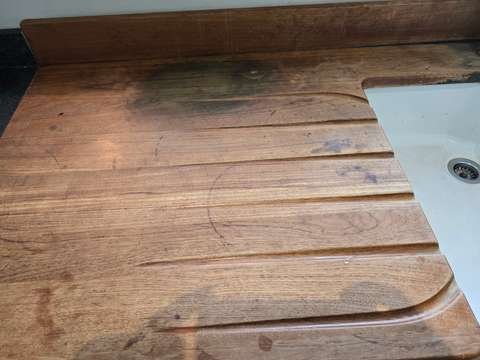
This is the result of a small pan fire where the oil spilled on to the worktop and the pan left a burn ring on the surface.
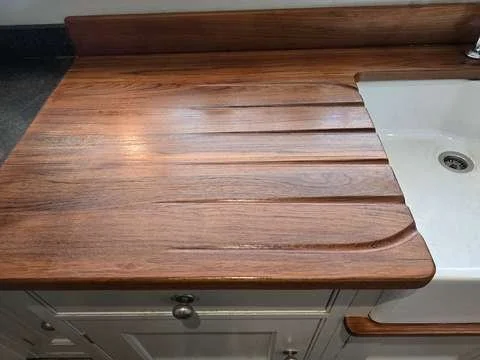
The burn marks have been completely removed from the Iroko worktop, we gave the entire surface a fresh coat of protective hard wax oil.
Our Step-by-Step Heat Damage Restoration Process
To completely erase or drastically minimize thermal damage without compromising the level run of your worktops, we follow a strict trade sequence:
Step 1: Scraping Away the Burnt Wood
Before any sander touches the wood, we must isolate the damaged area. If you try to sand a deep black carbon burn immediately, the loose charcoal particles will grind right into the open pores of the clean, surrounding timber, creating a permanently muddy, grey smudge.
We use an ultra-sharp Hamilton Perfection Precision Paint Scraper fitted with a fresh carbide blade to meticulously flake away the charred wood cells until we strike fresh, unburnt, healthy wood fibers.
Step 2: Gradient Blending to Preserve a Level Surface
Once the dead charcoal is gone, we are left with a minor, localized shallow dip. To make this dip completely invisible to both the eye and hand, we use a wide-radius gradient step-down sequence with our industry-leading Mirka DEROS random orbital sander:
The Core (40-Grit): We level out the immediate edges of the excavated burn site using a high-cut 40-grit disc over a tight, localized zone.
The Transition (80-Grit): We expand our sanding radius outward by an extra 20cm in every direction using an 80-grit sequence, gradually tapering the timber height down toward the repair core.
The Final Blend (120-Grit Mesh): We finish by expanding the radius another 20cm outward with Mirka Abranet 120-grit ceramic mesh discs to ensure the wood fibers don't burnish.
By stretching the height transition across a wide, sweeping radius, the physical dip is rendered so gradual that it becomes completely undetectable under flat kitchen lighting.
Step 3: Matching the Color to the Rest of Your Kitchen
Excavating a burn exposes raw timber that has been completely shielded from light and oxygen. This fresh wood will naturally look significantly lighter than the matured, UV-exposed timber across the rest of your kitchen. To bridge this contrast, we use trade-only Liberon Palette Wood Dyes, artistically blending the grain lines to seamlessly match the tone and character of the surrounding matured run.
Step 4: Locking in the Protection with Premium Hardwax Oil
Once the color match is flawless, we lock in the repair zone. We apply multiple coats of premium Fiddes Hardwax Oil using synthetic brushes. Unlike hardware store finishes that dry slowly and sit on top of the surface, our trade-grade hardwax oil penetrates deep into the raw grain, bonding at a molecular level to restore an incredibly tough, highly water-repellent, antimicrobial barrier.
An Honest Note on Expectations from a Master Craftsman
If a boiling cast-iron pan or a hot baking tray has been left sitting on a worktop for a sustained period, the intense thermal energy can scorch the timber fibers halfway through a 40mm solid wood slab.
We offer our specialised scraping and gradient blending techniques to remove dark worktop damage across all locations within Surrey, Hants and Berks. We will entirely remove standard scorches and dramatically improve deep burns. A deep-seated repair may still retain a slight character variation under close scrutiny. For the absolute finest, showroom-level result across your entire kitchen, we highly recommend having the entire interconnected section or run of worktops completely stripped back, uniform-sanded, and re-sealed at the same time.
Frequently Asked Questions
Can I use a chemical bleach or hydrogen peroxide to turn a black burn white?
Never attempt this. Chemical wood bleaches only neutralize iron-tannate reactions (water stains). They cannot reverse carbonization. Applying liquid chemicals to a dry carbon burn will only turn the charcoal into a soft, mushy paste that sinks deeper into the porous wood grain, permanently ruining the timber's structural integrity.
How heat-resistant will my worktop be after you apply Fiddes Hardwax Oil?
Fiddes Hardwax Oil offers exceptional day-to-day durability and excellent liquid resistance. However, no natural oil finish on earth can withstand the direct thermal shock of metal straight from an oven or hob. To safeguard your 5-year finish lifecycle investment, always use localized trivets, insulated mats, or worktop savers for hot pans and kettles.
Will the scraping and sanding process create a mess in my kitchen?
Not at all. Our entire mechanical process is hooked directly into a high-powered Makita VC4210M M-Class dust extractor. It actively captures 99% of airborne particles right at the sander head before they can escape, keeping your kitchen's air completely breathable, clean, and safe from start to finish.
Need Your Burned or Scorched Worktops Restored?
We provide precision mechanical burn extraction, dustless gradient blending, and premium hardwax oil sealing for domestic kitchens.
Learn more about our local regional coverage on our main [Surrey Worktop Restoration Services] hub.
Explore our full range of specialist fixes on our main [Wood Worktop Sanding & Restoration] service page.